


Which Camo Pattern Actually Works: A Field Guide to Our Cordura Colorways
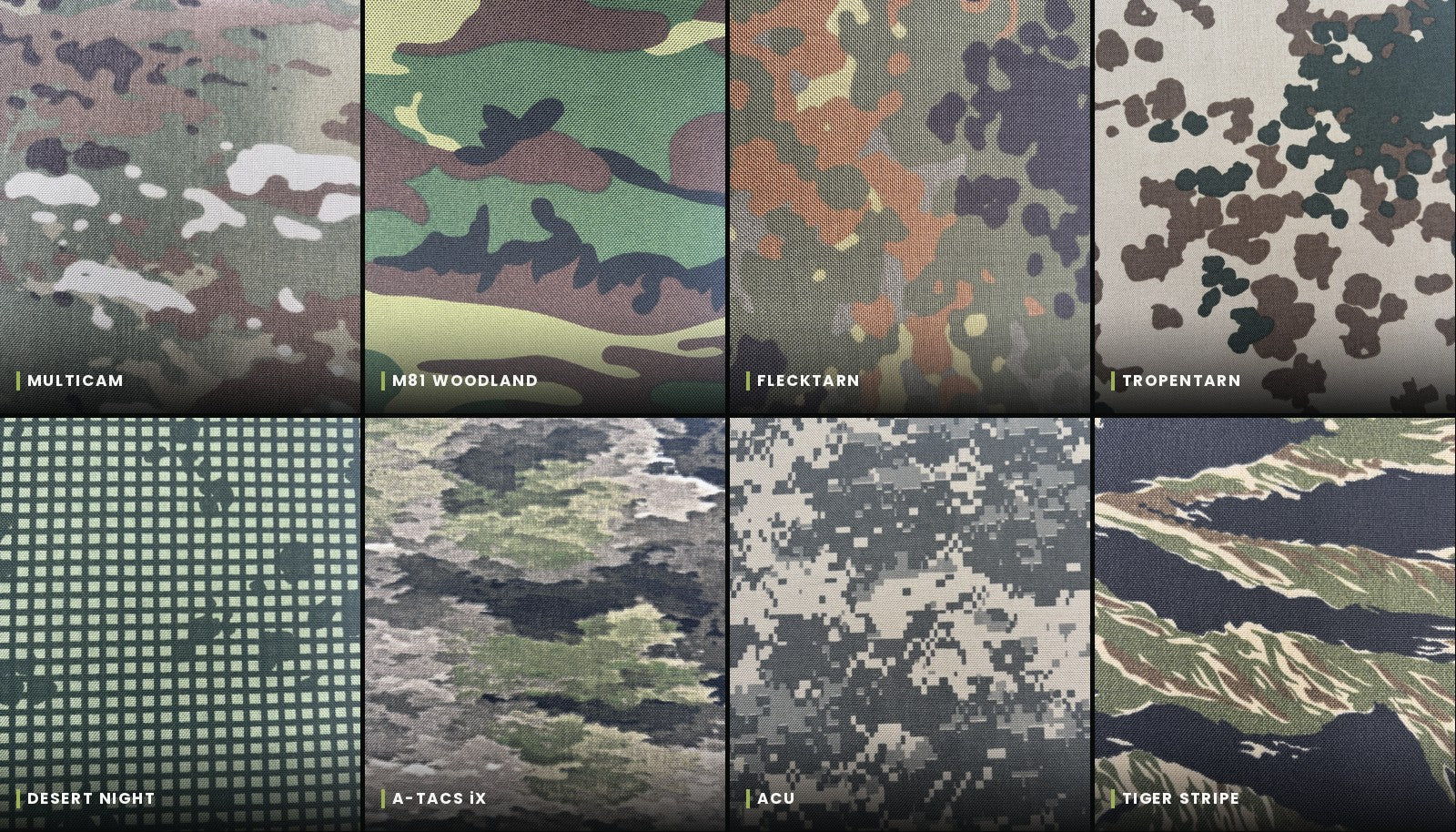
We cut a lot of colorways. Most people pick on looks, which is a perfectly good reason. But every one of these patterns was designed for a specific environment by a specific military, and some of them are genuinely better in some places than others.
Here's the field guide.
The solids
Black. Disappears in a holster, in a safe, at night. Stands out badly in daylight against almost any natural background — there is very little true black in nature. Our best seller by a wide margin, because most people want the gun to look like a gun.
Coyote. The US military's replacement for tan. Works across desert, dry grass, dead leaves and dust. The single most versatile solid we make.
OD Green. Olive drab, the classic. Deep summer woods, dark foliage. Reads slightly "vintage" against modern gear, which some people want.
Ranger Green. Greyer and more muted than OD. It's what most modern plate carriers and belts are cut from, so if you're matching a rig, this is usually the one.
The woodland patterns
M81 Woodland. The US pattern from 1981 — black, brown, green, tan in large organic blobs. Designed for temperate deciduous forest and still excellent there. The large blob size is what makes it work at distance and what makes it look odd on something as small as a pistol grip.
Flecktarn. German. Instead of large shapes it uses dense small spots that blend at distance into an average tone. Genuinely one of the best-performing patterns ever tested in European woodland, and the small scale means it reads correctly on small items — it looks right on a grip in a way M81 doesn't.
Tropentarn. Flecktarn's desert sibling, same spot structure in tan and brown. Dry scrub, sand, arid country.
The MultiCam family
MultiCam. Designed to work across multiple environments rather than perfectly in one — blended transitions instead of hard edges, so the eye can't lock onto a shape. It is the most recognisable camo pattern in the world right now and the most requested colorway we make after Black.
MultiCam Black. The law-enforcement variant. Black, greys and a little blue. Not a concealment pattern in any natural environment — it's a look, and a very good one. Pairs with black kydex and black guns better than anything else we cut.
The digital and specialist patterns
ACU. The US Army's Universal Camouflage Pattern — grey-green pixels. Famously did not work in the field, which is why the Army moved on. As a colorway it's a distinctive light grey-green that looks unlike anything else.
ACU (Desert). The tan variant. Genuinely useful in sand and dry gravel.
A-TACS iX. A modern pattern using organic pixel clusters at multiple scales, in a warm neutral palette. Built for mixed terrain — dry grass, rock, light brush. One of the more effective patterns we carry for actual concealment.
Desert Night Camo. The grid pattern the US issued in the late 1980s, designed to defeat first-generation night vision. Obsolete for its original purpose and completely distinctive because of it. People buy it because nothing else looks like it.
The tiger stripes
Tiger Stripe (Green/Black). The Vietnam pattern — dense horizontal brush strokes. Designed for dense jungle where vertical light and shadow dominate. Still works remarkably well in thick green.
Tiger Stripe (Desert). Same structure, arid palette.
Tiger Stripe (ABU). The Air Force blue-grey variant. Not a concealment pattern for ground use — a distinctive light grey-blue with real history behind it.
How to actually choose
If you want the gun to disappear on your body: Black or Ranger Green.
If you want it to disappear in your environment: Flecktarn for temperate woods, Coyote or Tropentarn for dry country, A-TACS iX for mixed.
If you want it to match your rig: Ranger Green, Coyote or MultiCam — those three cover most modern gear.
If you want it to look like nothing anyone else has: Desert Night Camo.
Every pattern is cut from the same Cordura 1000D across grips, optic wraps, light wraps and magazine wraps — so a matched set actually matches. That sounds obvious. It is not how most of the industry works.
