


Does Grip Tape Damage Your Gun? What Actually Happens to the Frame
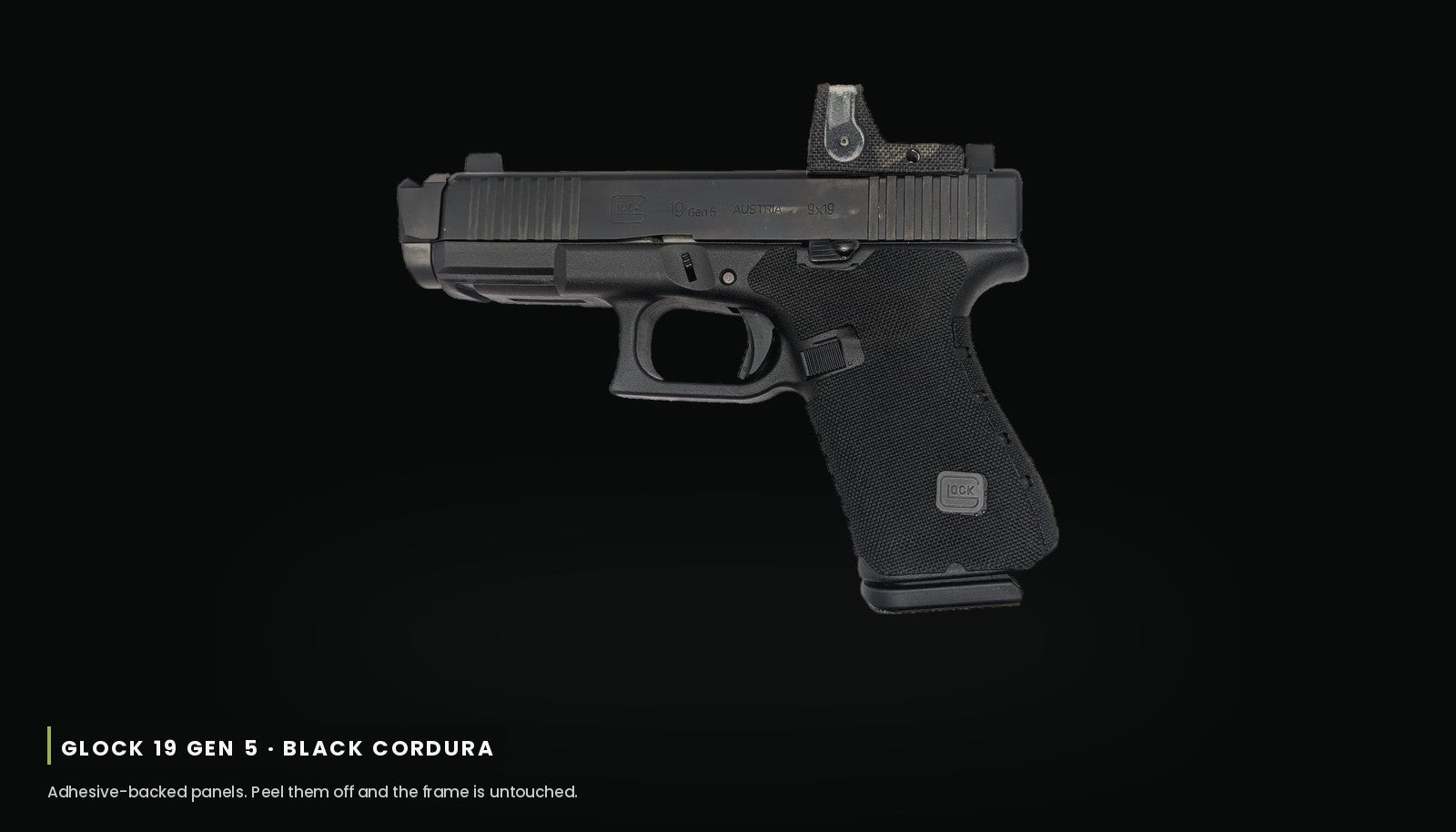
This is the question we get more than any other, and it usually arrives with a note of real worry attached. Somebody has just spent $600 on a pistol and the idea of sticking something to it permanently is uncomfortable. Fair enough.
So here is the straight answer, including the parts that aren't flattering.
What the adhesive actually is
Our wraps are backed with 3M Low Surface Energy (LSE) adhesive. LSE is a specific category, and the name matters: polymer pistol frames are low surface energy materials, meaning most adhesives struggle to bond to them at all. Standard tape either falls off in a week or, worse, uses an aggressive solvent-based glue that grabs hard and leaves residue when it comes off.
LSE adhesive is engineered for exactly this problem. It holds through heat, sweat, oil and recoil, and it releases cleanly because it was never designed to chemically bond with the polymer in the first place — it's a mechanical grip, not a chemical one.
What happens to a polymer frame
Nothing. A Glock, a P320 grip module, a Hellcat frame — these are glass-filled nylon. The adhesive sits on the surface, comes off the surface, and the surface is unchanged underneath. We've pulled wraps off guns that wore them for two years and the stipple pattern underneath looks exactly like the day it was covered.

If there's residue — and occasionally there is, on a wrap that's been on a long time in a hot climate — it wipes off with isopropyl alcohol and a paper towel. Not acetone. Not brake cleaner. Isopropyl.
What happens to a metal frame
Also nothing, with one caveat worth stating plainly. On a Cerakoted or anodised surface that was applied badly — thin coverage, poor prep, already flaking — pulling any adhesive off can lift the finish with it. That's a pre-existing coating failure, not something the wrap caused, but it will feel like the wrap caused it. If your Cerakote is already chipping at the edges, think twice.
Bare steel and aluminium are fine. Factory Cerakote from a reputable shop is fine.
What about resale?
A wrapped gun sells the same as an unwrapped one, because you take the wrap off before you sell it and nobody can tell it was ever there. This is the genuine advantage over the alternatives. Stippling is permanent — you melted the frame. Aggressive skate tape leaves adhesive shadow and sometimes lifts the texture. A Cordura wrap is reversible in about four minutes.
The honest downsides
We'd rather you hear these from us.
It is not a lifetime product. A wrap that's carried daily, appendix, against a sweaty body, through a Pennsylvania summer, will start looking tired somewhere between twelve and twenty-four months. It's fabric. Fabric wears. That's also why it feels good.
Holster fit changes slightly. Cordura 1000D adds roughly 0.5mm. Most kydex holsters absorb that without complaint. A very tight custom holster with minimal retention adjustment might need a quarter-turn on the screws.
It won't fix a grip that's the wrong size for your hand. A wrap changes texture, not geometry. If the gun is too fat or too thin for you, it will still be too fat or too thin.
How to remove it
Warm it. A hairdryer on low for thirty seconds, or leave the gun in a warm room. Start at a corner and pull slowly, back on itself at a sharp angle rather than straight up. It comes off in one piece. Wipe with isopropyl if anything's left.
That's it. No solvents, no scraping, no heat gun.
The short version
Polymer frames: no risk. Metal and factory Cerakote: no risk. Failing aftermarket coatings: think twice. Everything about a Cordura wrap is reversible, which is the entire reason we build them this way instead of telling you to take a soldering iron to a $600 pistol.
