


Skate Tape vs. Cordura: What 500 Rounds Does to Your Hands
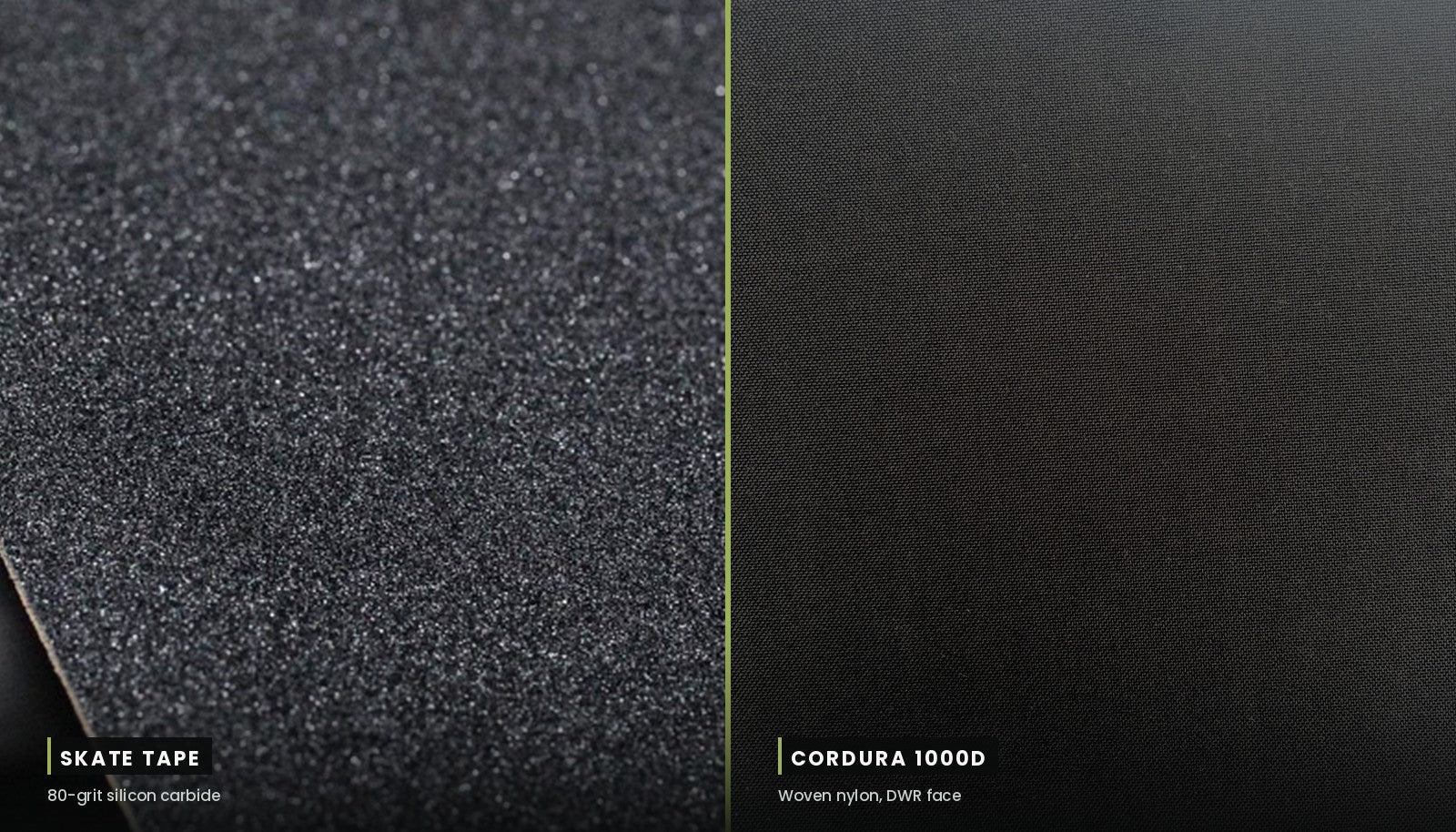
Search "gun grip tape" and almost everything you find is skate tape — silicon carbide grit bonded to an adhesive backing, cut into a pistol-shaped outline. It's cheap, it's everywhere, and it does genuinely work.
We built the company because we thought there was a better answer. Here's the comparison without the marketing.
What grit is good at
Let's be fair to it first. Silicon carbide grit gives you the most aggressive purchase available short of stippling. Wet hands, gloved hands, blood, oil — grit does not care. If your entire criterion is "maximum traction under the worst conditions," grit wins and nothing else is close.
Competition shooters who draw a hundred times a day from an open holster and never carry concealed are perfectly well served by it.
What grit costs you
Your hands. Five hundred rounds of a two-day class with a grit-taped gun and your support-hand palm is raw. Not sore — abraded. People tape their hands to shoot their taped gun, which should tell you something.
Your clothes. This is the one nobody mentions before you buy. A grit-taped gun carried appendix under a t-shirt will destroy that t-shirt. Not eventually — within a few weeks you'll have a fuzzy patch, then a hole. Multiply by every shirt you own.
Your holster. Grit is an abrasive. Kydex is a plastic. Draw a few thousand times and you are running sandpaper against your holster's interior.
Concealment. Grit grabs cover garments on the draw. That's a real problem, not an aesthetic one.
Where Cordura sits
Cordura 1000D is a woven ballistic nylon. It's what good backpacks, plate carriers and duty gear are made from, because it's abrasion-resistant, holds up to weather, and is comfortable against a body all day. That last part is the point.
The texture comes from the weave, not from a bonded abrasive. Under a dry hand it gives you noticeably more purchase than bare polymer. Under a wet hand it gives you more still, because the weave channels water instead of sitting on a slick surface. It will not match grit at the extreme end — we're not going to pretend otherwise.
What it does instead is not cost you anything. It doesn't sand your palm. It doesn't eat shirts. It doesn't chew your holster. And it's reversible in four minutes.
The honest decision matrix
Choose grit if: you shoot competition from an open holster, you rarely carry concealed, and absolute maximum traction is the only variable you care about.
Choose Cordura if: you carry the gun on your body, you take classes, you'd like your shirts to survive, or you ever intend to sell the pistol.
Choose stippling if: you're certain about the gun, certain about the texture, and comfortable that the decision is permanent.
Why nobody made this before
Because bonding fabric to a low-surface-energy polymer frame is genuinely difficult. Standard adhesives don't hold to glass-filled nylon — they either peel in a week or grip so hard they leave residue. It took 3M LSE adhesive and a lot of laser-cutting iterations to get a wrap that holds through a humid August and still comes off clean.
That's the whole idea: a functional grip made from a fabric built to be worn, rather than an abrasive built to remove material.
